
Municipal code in Toronto mandates that any waste container placed on city property must maintain a minimum 1.5-meter clearance for pedestrian traffic. GTA property owners conducting interior renovations face immediate project shutdowns if temporary disposal solutions obstruct these strict rights-of-way. These non-negotiable legal constraints dictate the physical logistical flow of every urban project.
Permit Requirements for GTA Street Placement
Navigating Municipal Encroachment Rules
Fines exceeding $500 instantly halt projects that obstruct Toronto sidewalks without a validated Street Occupation Permit. This administrative penalty triggers immediate municipal enforcement, forcing crews to abandon active demolition. Securing legal staging ground remains the only viable method to maintain your established construction schedule without incurring severe local infractions.
High-density Victorian rows in Downtown Toronto strictly require a 3.05-meter roadway clearance alongside the pedestrian mandate to ensure emergency vehicle access. Navigating these narrow footprints means street permits are the only legal option for staging heavy debris. Operators must scrutinize official municipal guidelines before dispatching any equipment.
Operating near designated 2026 FIFA World Cup restricted areas demands extreme logistical foresight, as routine encroachment requests face automatic rejection. Furthermore, properties situated within active development zones are now subject to a Construction Hub 25% surcharge on all municipal permit applications.
Securing this legal staging ground demands accurate site mapping before the first sledgehammer swings. Inspectors relentlessly patrol high-traffic corridors, issuing stop-work orders the moment a container touches the asphalt without visible permit documentation displayed on the premises.
- Pedestrian Clearway: A minimum 1.5-meter path must remain unobstructed at all times for local safety.
- Processing Delay: Permit applications require a minimum of 10 calendar days for approval.
- Roadway Width: Maintaining a strict 3.05-meter roadway width ensures heavy transit flow.
Weight Thresholds for Tile and Masonry Debris
Understanding Axle Loads and Road Safety
Current SPIF regulations governing heavy commercial transport dictate the absolute mass a roll-off truck can legally pull from a residential driveway. These strict Ministry of Transportation parameters prevent subsurface asphalt destruction while keeping mechanical systems within safe operating tolerances. Operators track every heavy vehicle weight standard rigorously.
Property owners routinely assume a 40-yard bin represents the ultimate solution for massive tile and mortar removal. In reality, loading dense masonry into massive containers causes trucks to exceed legal limits before reaching half capacity. Smart contractors in Etobicoke utilize smaller construction bin rentals for heavy material phases.
Transporting overweight loads during the volatile half-load season restrictions from March to May drastically increases enforcement scrutiny. Commercial carriers who violate these seasonal thresholds suffer immediate CVOR points against their safety rating, which can severely impact their ability to dispatch trucks to your job site.
Overloaded bins also create severe liability during the physical winching process. If a container exceeds structural weight ratings due to densely packed concrete, the immense cable tension can catastrophically snap, endangering operators and devastating residential infrastructure in the immediate drop zone.
Disposal Protocol for Obsolete Plumbing and Electrical
Segregating Hazardous Renovation Materials
Disposing of modern drywall offcuts requires standard volume planning, but extracting lead pipes or asbestos-laced venting triggers severe environmental containment protocols. Older GTA properties conceal these banned substances inside sealed wall cavities. Failing to segregate this hazardous matter violates Bill 98 environmental standards and forces devastating remediation costs.
Standard mixed waste bins perfectly accommodate general C&D debris, but burying even a trace fragment of regulated hazardous material guarantees absolute load rejection. Processing facilities in Mississauga maintain militant inspection lines. Contaminated loads are immediately returned to the origin site under strict provincial liability mandates.
The impending Circular Materials transition forces contractors to track the lifecycle of every extracted commodity precisely. Properly separating clean metals from mixed C&D debris ensures compliance with evolving provincial recovery targets while protecting the property owner from post-disposal administrative audits.
Segregating hazardous waste demands dedicated staging zones before disposal. Mixing prohibited toxic materials with standard debris forces transfer stations to quarantine the load, instantly transferring immense financial penalties back to the origin site owner.
Space Requirements for Cabinetry and Demolition Waste
Maximizing Internal Bin Volume
Contractors consistently debate whether extracting hollow kitchen cabinetry necessitates upgrading from a standard 14-yard container to a massive 20-yard footprint. Hollow wooden structures consume massive vertical capacity without adding measurable payload mass. Evaluating structural density prevents budget overruns on high-volume removals.
Internal air pockets destroy project budgets. Smashing cabinetry flat maximizes the geometric utility of a 20-yard rental and prevents costly secondary dispatches.
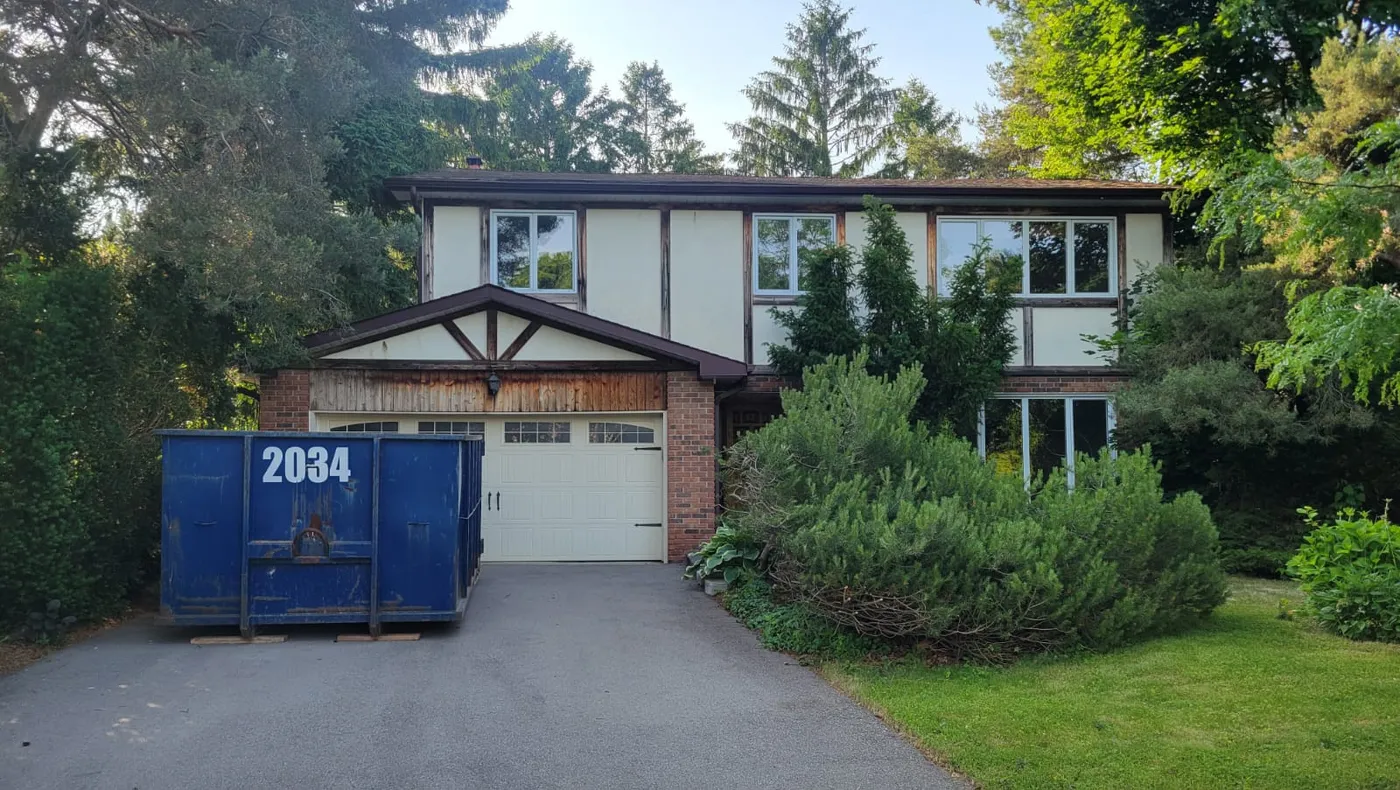
Deploying thick 3/4-inch plywood driveway shielding before dropping these heavy containers protects fragile interlocking stone from extreme hydraulic pressure. Without this critical physical barrier, the sheer mass of compressed demolition waste will permanently crush residential driveway surfaces during the lift phase.
Proper volumetric planning also involves staggering the removal phases of your project. Loading light, bulky timber above densely compacted floor tiles balances the internal weight distribution, ensuring the driver can secure the transport tarp smoothly before entering municipal roadways.
Site Readiness and Overhead Clearance Hazards
Avoiding Common Delivery Failure Points
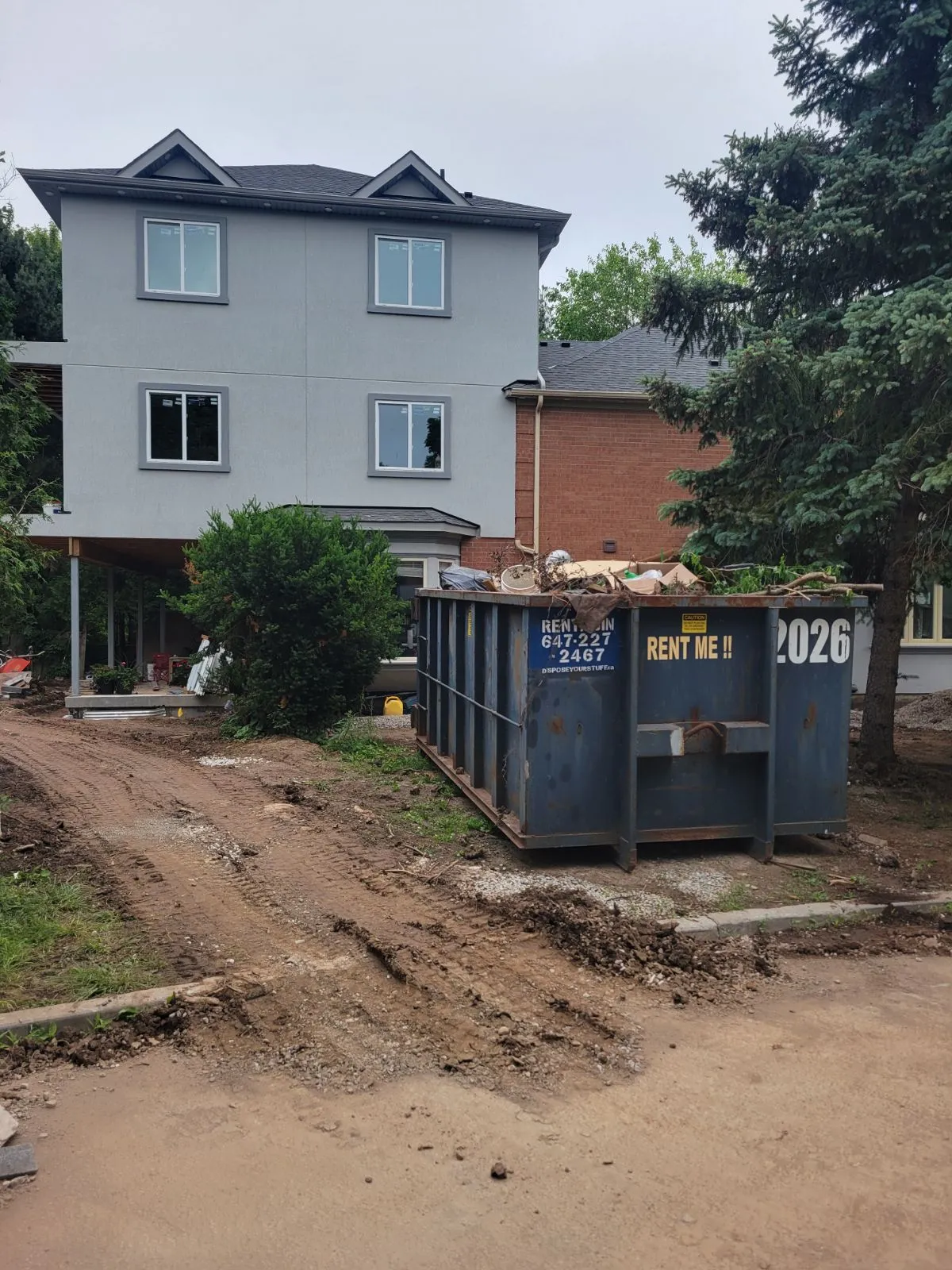
Dense tree canopies and sagging telecommunication lines dominating Old East York directly obstruct the operational arc of hydraulic roll-off lifts. These legacy neighborhoods present severe mechanical challenges for delivery drivers. Securing compliance with Electrical Safety Authority clearance standards prevents catastrophic utility line severing.
A rigid 14-foot vertical clearance remains non-negotiable for safe tilt-hoist operation. Operating massive hydraulic cylinders beneath this threshold risks snagging residential power drops or fracturing mature tree limbs. Drivers will instantly abort any delivery attempt that breaches this fundamental spatial requirement.
Ground-level staging carries identical regulatory weight, demanding a 2.0-meter fire hydrant clearance to appease local fire code enforcement. Furthermore, situating equipment too close to street corners violates the strict 9.0-meter intersection setback, which guarantees sightlines for turning commercial traffic.
Municipal parking enforcement officers actively target unauthorized bins that violate intersection sightlines. Failing to establish the strict 9.0-meter intersection setback not only risks immediate fines but often results in the city ordering an emergency tow of the fully loaded container at your expense.
Final Site Preparation Protocol
Confirming Physical Access Constraints
Verify overhead clearance and measure the driveway slope to ensure it does not exceed the maximum safe angle for heavy bin placement.
Execute a final perimeter sweep to confirm the physical container footprint strictly honors the required 9.0-meter intersection setback and hydrant boundaries. This proactive physical verification guarantees the incoming hydraulic lift can safely disengage its payload without triggering immediate municipal enforcement action.