
Property owners and general contractors across the Greater Toronto Area risk fines exceeding $10,000 for improper bin placement. Failing to account for municipal bylaws in Toronto or Mississauga can halt a construction project before the first load of debris is removed.
GTA Waste Management Regulations and Compliance Standards
Municipal Bylaws and Financial Accountability
Bylaw enforcement officers in the City of Toronto apply Toronto Municipal Code Chapter 743 to regulate any temporary obstruction of the public right of way. This specific regulation dictates the exact distance a waste container must maintain from the curb and neighboring property lines to ensure pedestrian safety.
A residential renovation in Etobicoke or Scarborough requires a clear understanding of where private property ends and the municipal road allowance begins. Misjudging this distance by even a few inches results in the immediate issuance of a work-stop order and solid waste management fees being levied against the site.
Site managers often mistake private driveways for exempt zones, but Chapter 629 Property Standards require that even containers on private land remain free of overflowing debris and vermin. Maintaining a clean site is not merely a courtesy to neighbors but a legal requirement that prevents escalating administrative penalties.
2026 Regulatory Compliance Alert
The 2026 increase in municipal solid waste management fees has intensified bylaw enforcement across the GTA. Maintaining active permit documentation on-site is the only verified method to avoid project impoundment during routine municipal inspections of your disposal equipment.
Permit Requirements for Public Property Placement
Navigating Right of Way and Sidewalk Occupation
Does every bin rental require a city permit? Any bin placed on a sidewalk, boulevard, or curb lane in Toronto requires a Temporary Street Occupation Permit, which must be secured through the Toronto Transportation Services portal at least 48 hours before delivery.
The Peel Region waste transition has shifted several management responsibilities to new jurisdictional bodies, requiring contractors to verify if private collection contracts or municipal services govern their specific zone. This change is particularly relevant for sites near the border of Mississauga and Brampton where service areas overlap.
Municipalities across the GTA have transitioned to a model where Circular Materials now manages the recycling stream for residential projects. This shift ensures that high-volume construction debris is handled through specialized bin rental in Mississauga to maintain strict compliance with new provincial resource recovery protocols.
Restricted Materials and Provincial Waste Standards
Environmental Compliance and Diversion Mandates
Ontario’s Waste Diversion Act and the Resource Recovery and Circular Economy Act strictly prohibit the disposal of hazardous liquids or electronic waste in standard mixed waste bins. These circular economy mandates ensure that toxic components do not contaminate local soil or groundwater systems.
Large-scale projects exceeding 2,000 square metres must implement a Waste Reduction Work Plan (WRWP) under O. Reg. 102/94. This plan requires a comprehensive strategy for source separation programs to divert recyclable materials like clean wood and scrap metal from the general waste stream.
Management of O. Reg. 406/19 (Excess Soil Management) is now a critical component for any GTA excavation project. These regulations require that a Qualified Person (QP) oversees the movement of soil and that all filings are correctly registered with the RPRA (Resource Productivity and Recovery Authority).
- Extended Producer Responsibility (EPR) ensures that manufacturers are accountable for the end-of-life management of products found in construction waste.
- Resource Recovery Protocols mandate the separation of clean fill from mixed debris to facilitate industrial recycling processes.
- RPRA Registry Filings are mandatory for any project involving the relocation of excess soil to prevent unauthorized environmental dumping.
Provincial Compliance Checklist
Verify that your project has an active Waste Reduction Work Plan if your site exceeds provincial square footage thresholds. Engaging a Qualified Person (QP) for soil testing is a mandatory step for any excavation exceeding current municipal volume limits.
Driveway Protection and Weight Distribution Requirements
Preserving Residential Surfaces During Heavy Deliveries
A fully loaded 40 Yard Bin can weigh several tons, exerting immense pressure on residential asphalt or interlocking brick during the high-temperature summer months. This mechanical stress can cause permanent indentations that require professional resurfacing once the project reaches completion.
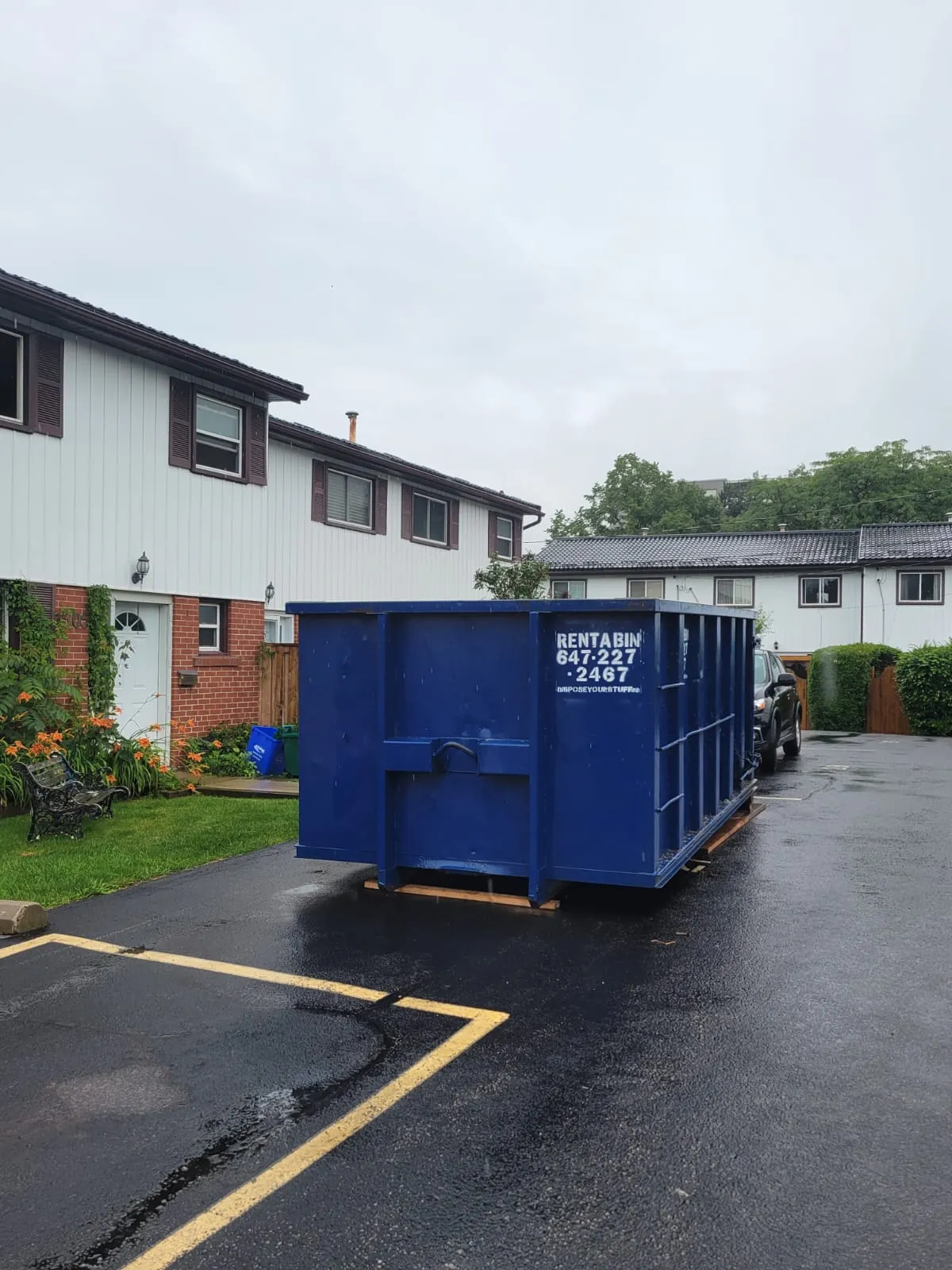
Always utilize 2x4 or 4x4 wood planks as a buffer between the steel rollers of a 14 Yard Bin and the ground surface. This simple logistical step distributes the load and preserves the structural integrity of the pavement during the intense pressure of the delivery cycle.
Weight management extends to the center of gravity within the container itself. Loading heavy materials like concrete or dirt on one side of a 20 yard bin can cause the delivery truck to exert uneven pressure on the driveway, leading to surface fractures that are difficult to repair.
Safety Standards for Large Scale Construction Bins
Visibility and Perimeter Security for Urban Work Sites
Many site managers assume that a construction bin on private property is exempt from visibility rules, but the Toronto Municipal Code Chapter 363 requires reflective markings on any container. These Construction and Demolition (C&D) standards ensure that equipment is visible to emergency vehicles in low-light conditions.
Open-top containers on active demolition sites in high-traffic areas like North York require a 1.2-meter public safety fencing perimeter. This physical barrier prevents unauthorized access and protects pedestrians from protruding debris or airborne dust generated during the loading process.

The construction bin rentals utilized for major teardowns must follow the Ontario Traffic Manual (OTM) standards for reflective tape. These markings must be placed on all four corners of the bin to catch vehicle headlights and signal the presence of heavy equipment in residential cul-de-sacs.
High-Traffic Safety Protocol
Active demolition sites must utilize perimeter safety fencing to enclose any waste container exceeding 20 yards. This preventative measure is essential for mitigating liability and ensuring your project remains within the safety bounds of local municipal building codes.
Operational Verification and Site Readiness
Technical Clearance and Final Delivery Audits
Is the path clear for a heavy roll-off truck to navigate the narrow streets of Old Toronto or the tight corners of Scarborough? Overhead obstructions, such as low-hanging power lines or tree branches, must be cleared to allow for the steep delivery angle required by the truck.
Consultation with the Electrical Safety Authority Ontario ensures that safe distances from utility infrastructure are maintained during the drop-off. A final site audit performed 24 hours before delivery ensures that no parked vehicles or fresh landscaping will obstruct the heavy equipment.
Successful bin rental in the GTA is a product of early planning and adherence to municipal standards. Before scheduling a delivery, every property owner should perform a final site audit to ensure the location is unobstructed and all permits from the relevant municipal portal are active.